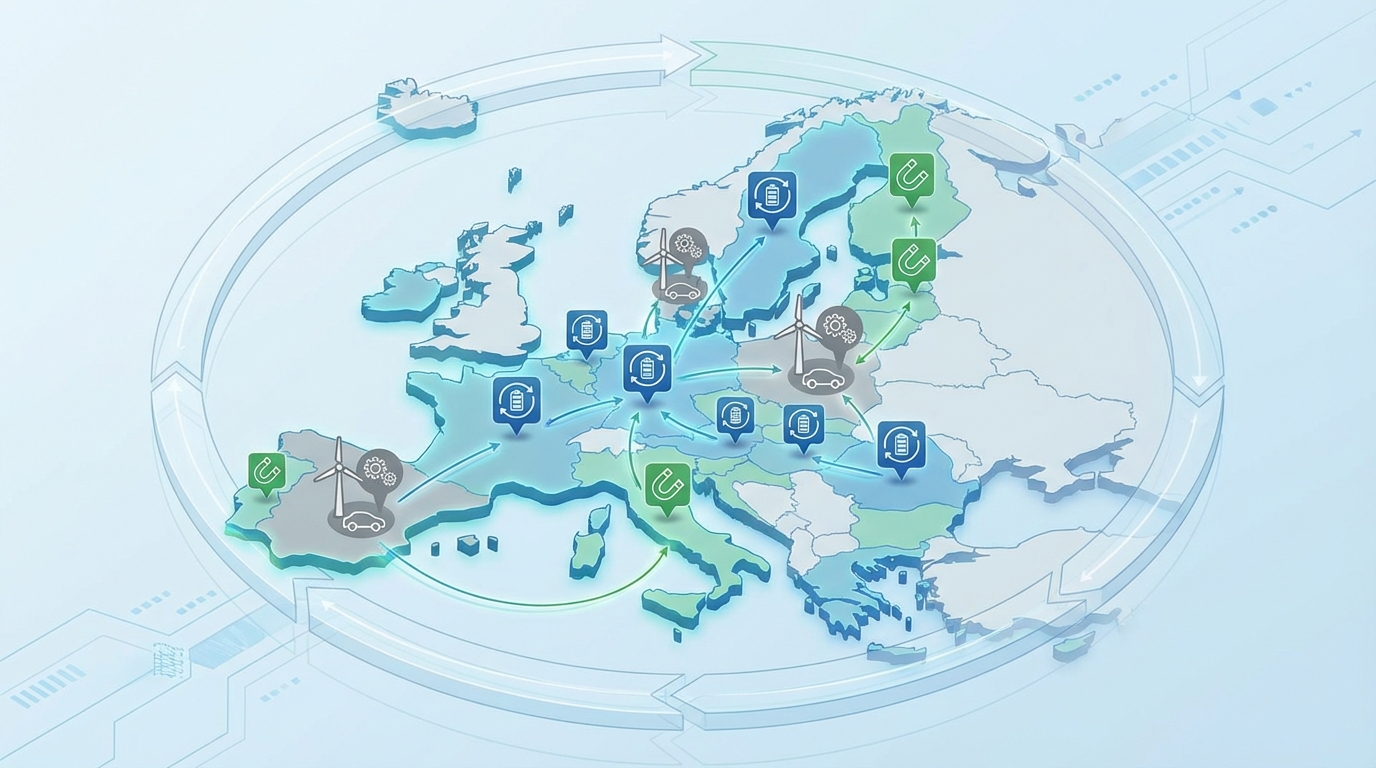
Concern around the 15% recycling benchmark in the EU Critical Raw Materials Act (CRMA) does not come from abstract sustainability debates. It comes from very concrete moments: magnet and battery suppliers suddenly unable to ship after export control announcements, board‑level calls triggered by rare earth price spikes, and compliance teams scrambling to interpret new traceability rules that land mid‑contract. In past sourcing cycles, assumptions that “recycling will catch up later” repeatedly collided with slow permitting, limited collection rates, and technology that was brilliant in pilot form but stubbornly hard to industrialise.
Against that backdrop, the CRMA’s requirement that at least 15% of EU annual consumption of each strategic raw material (SRM) should come from recycling by 2030 is not just another environmental target. It rewires how demand planners, procurement desks and asset‑level engineers have to think about end‑of‑life flows for magnets, batteries, and other SRM‑rich components. The regulation translates supply‑security anxiety into legally monitored benchmarks, and that is what makes it structurally different from previous, largely voluntary recycling ambitions.
Key points at a glance
- The CRMA, adopted on 18 March 2024, sets a binding benchmark that by 2030 at least 15% of EU annual consumption of each strategic raw material should be met by domestic recycling capacity, as part of the wider “10‑15‑40” rule.
- This sits against current EU recycling rates for most SRMs that remain well below 1%, particularly for permanent magnet rare earths and several battery metals, implying an order‑of‑magnitude scale‑up in a short timeframe.
- Digital product passports, permitting fast‑tracks for “Strategic Projects”, and a cap that limits reliance on any single third country to 65% of supply are the main regulatory levers linking recycling to supply‑security objectives.
- Direct recycling of permanent magnets and bioleaching of battery “black mass” emerge in the material provided as the two most prominent technology pathways, with reported high recovery and energy‑saving potential but significant scaling constraints.
- If implemented as written, the CRMA is likely to reconfigure sourcing strategies for EV, wind and defence value chains, though the degree of change will depend on project execution, collection logistics, and how strictly member states enforce penalties and monitoring.
FACTS: Regulatory framework, scope and current baseline
CRMA scope and the 10‑15‑40 rule
The Critical Raw Materials Act is an EU regulation adopted on 18 March 2024. It identifies 34 critical raw materials (CRMs) and within them a subset of 17 strategic raw materials (SRMs) that are considered essential for green, digital and defence applications. This SRM subset includes, among others, lithium, cobalt, nickel, natural graphite, manganese, certain rare earth elements (used in permanent magnets), and several technology metals such as gallium and silicon metal, according to European Commission materials and technical factsheets cited in the source list.
The CRMA frames three quantitative benchmarks for 2030, often summarised as the “10‑15‑40 rule” for each strategic raw material:
- At least 10% of EU annual consumption should come from extraction within the EU.
- At least 40% should be processed (refined or transformed) within the EU.
- At least 15% should come from recycling within the EU.
In addition, the CRMA introduces a diversification constraint: no more than 65% of the Union’s annual consumption of any strategic raw material, at any relevant stage of processing, should originate from a single third country. This is explicitly designed to reduce the concentration risk associated with current dependencies, for example on Chinese processing for rare earths and several battery materials, which multiple analyses in the provided material describe as exceeding 90% of global capacity for some steps.
Some commentaries referenced in the input distinguish between the 15% recycling benchmark that appears in the core CRMA text for strategic raw materials and higher aspirational figures, such as 25% recycling for certain battery materials under other policy tracks. In practice, the 15% benchmark is the key legally monitored figure in the CRMA itself, while higher sector‑specific targets are discussed in parallel initiatives.
Timeline and implementation instruments
The CRMA is designed to move from adoption to effective monitoring over the second half of the 2020s. Based on the regulatory calendar outlined in the material provided and Commission communications, relevant milestones include:
- 2024-2025: Entry into force of the CRMA and preparation of national measures. EU‑level monitoring structures are established, and member states design their national contributions to the benchmarks.
- Q2 2025: Application of accelerated permitting for “Strategic Projects” in extraction, processing and recycling, with indicative maximum permitting durations (for example, 27 months for certain projects mentioned in the input material). The exact timelines are set out in the CRMA and may vary by project category.
- 2026-2027: Progressive rollout of digital product passports and related traceability requirements, especially for batteries, large industrial equipment and permanent magnets. Recycled‑content minima for some product categories (such as batteries) begin to apply under adjacent legislation referenced alongside the CRMA.
- 2027 onwards: Full monitoring of reliance on single third countries against the 65% cap, with the Commission empowered to flag excessive concentration and engage with member states and industry.
- 2030: Assessment of progress against the 10‑15‑40 benchmarks for each strategic raw material, with the possibility of further measures if gaps remain significant.
Member states are required to establish penalties for non‑compliance that are “effective, proportionate and dissuasive”. Some secondary sources cited in the input mention potential fines expressed as a percentage of turnover; the CRMA itself leaves the exact levels to be defined at national level, so any specific figure should be treated as an example rather than a harmonised EU‑wide rule.
Recycling baseline and supply concentration
Across most SRMs, the current EU recycling baseline is described in the supplied material as “below 1%” of annual consumption. Examples include:
- Very low recovery of neodymium, dysprosium and other magnet rare earths from end‑of‑life motors and generators, often quoted in the range of tenths of a percent.
- Early‑stage but still limited recovery of cobalt, nickel and lithium from spent lithium‑ion batteries, with only a small fraction of the end‑of‑life pool processed in dedicated EU facilities to date.
In parallel, EU consumption of many SRMs remains heavily concentrated on imports. The provided sources reference Chinese processing shares above 90% for several rare earth and battery‑related steps, and note that past export control announcements have triggered abrupt supply concerns and price spikes for elements such as dysprosium and magnet alloys. These episodes have directly shaped board‑level risk perceptions in sectors such as electric vehicles, wind power and defence.
Key regulatory levers for recycling
To bridge the gap between the current baseline and the 15% benchmark, the CRMA and associated policy instruments deploy several levers that affect supply‑chain operations:
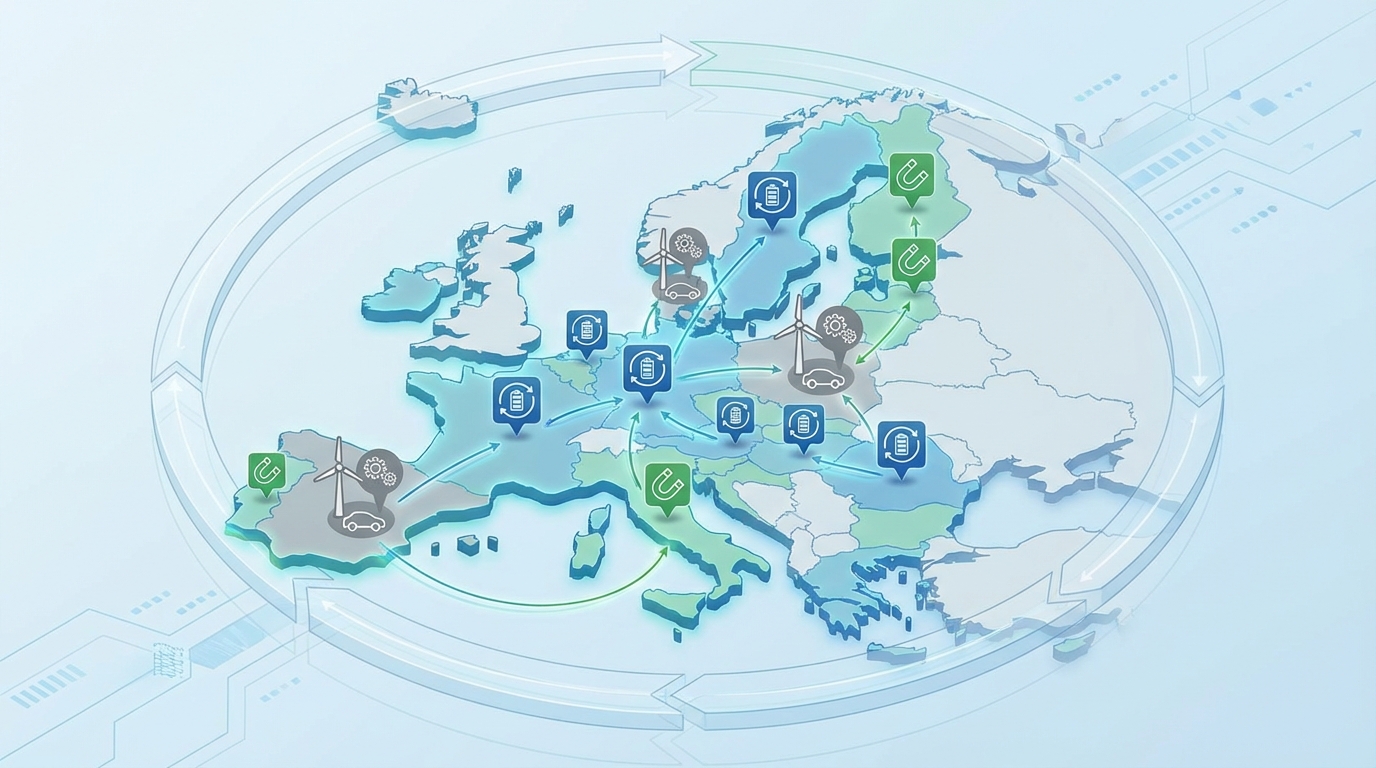
- Strategic Projects status: Recycling projects that qualify as “Strategic Projects” benefit from accelerated permitting, coordination support and increased visibility in EU monitoring. Criteria include contribution to CRMA benchmarks, technical feasibility and environmental performance.
- Digital product passports (DPPs): Phased‑in DPPs for batteries, large industrial equipment and other SRM‑containing products are intended to record composition, origin, and end‑of‑life instructions. This creates a data backbone for identifying and routing SRM‑rich waste streams.
- Waste and collection measures: The CRMA dovetails with waste and product legislation that sets collection obligations for electrical and electronic equipment and batteries. Several sources highlight that current collection rates for SRM‑containing products are well below potential, making this a critical constraint.
- Trade and transport rules: Basel Convention rules and their EU implementation affect cross‑border shipment of hazardous waste such as battery “black mass”. The input material notes that restrictions on exporting such materials outside the EU increase the relevance of local and regional recycling hubs.
- Recycled‑content and recyclability requirements: Related EU measures, especially for batteries and possibly for magnets, introduce minimum recycled‑content percentages and design‑for‑recycling criteria. While not all of these sit inside the CRMA text, they interact with the 15% benchmark by shaping demand for secondary materials.
Technology focus: direct magnet recycling and bioleaching
The material provided highlights two technical pathways as particularly impactful for meeting the recycling benchmark: direct recycling of permanent magnets and bioleaching of battery materials.
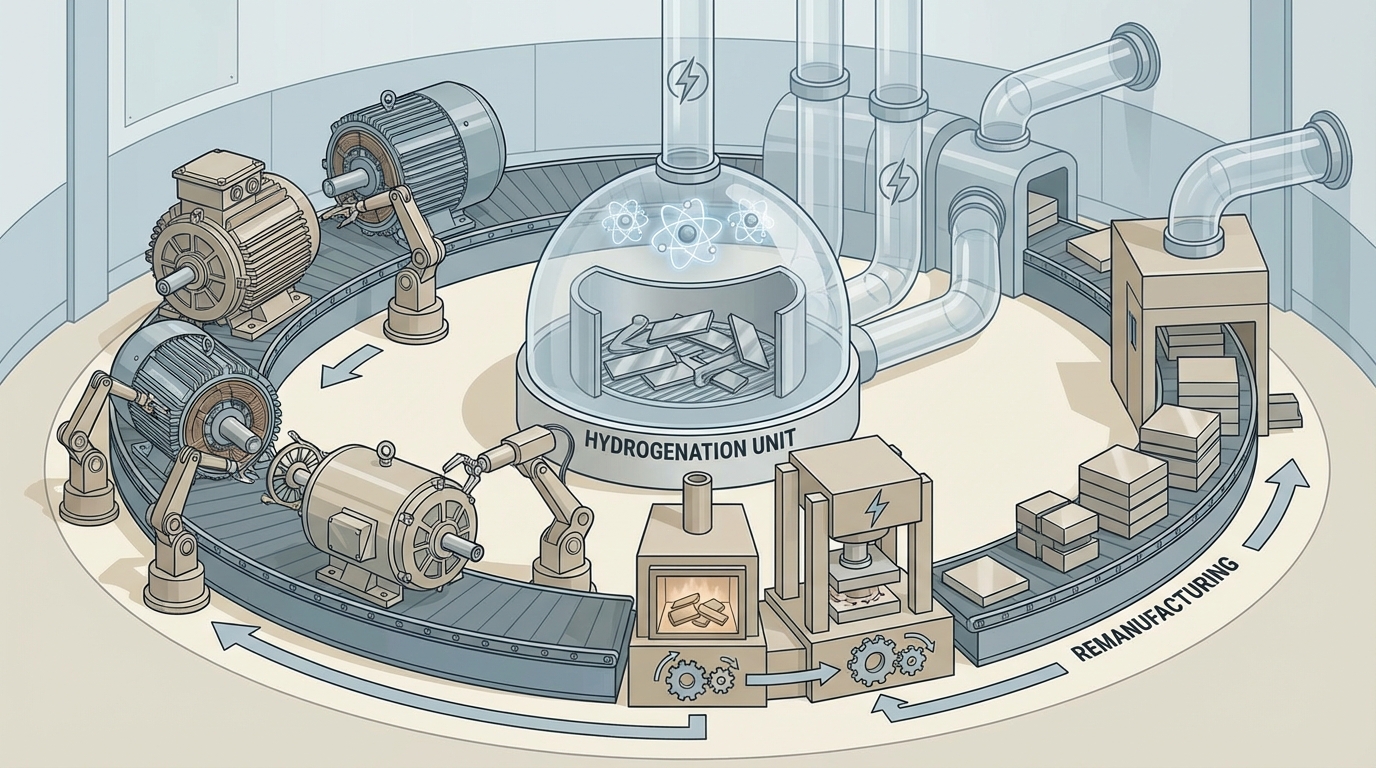
Direct magnet recycling targets neodymium‑iron‑boron (NdFeB) and similar magnets used in EV motors, wind turbines and defence actuators. Instead of shredding whole components and recovering elements via high‑temperature routes, direct processes disassemble magnets and reprocess them more selectively (for example through hydrogen‑based decrepitation or controlled delamination). Reported benefits in the source material include energy savings on the order of 90% relative to primary production and very high material recovery rates when magnets can be accessed intact.
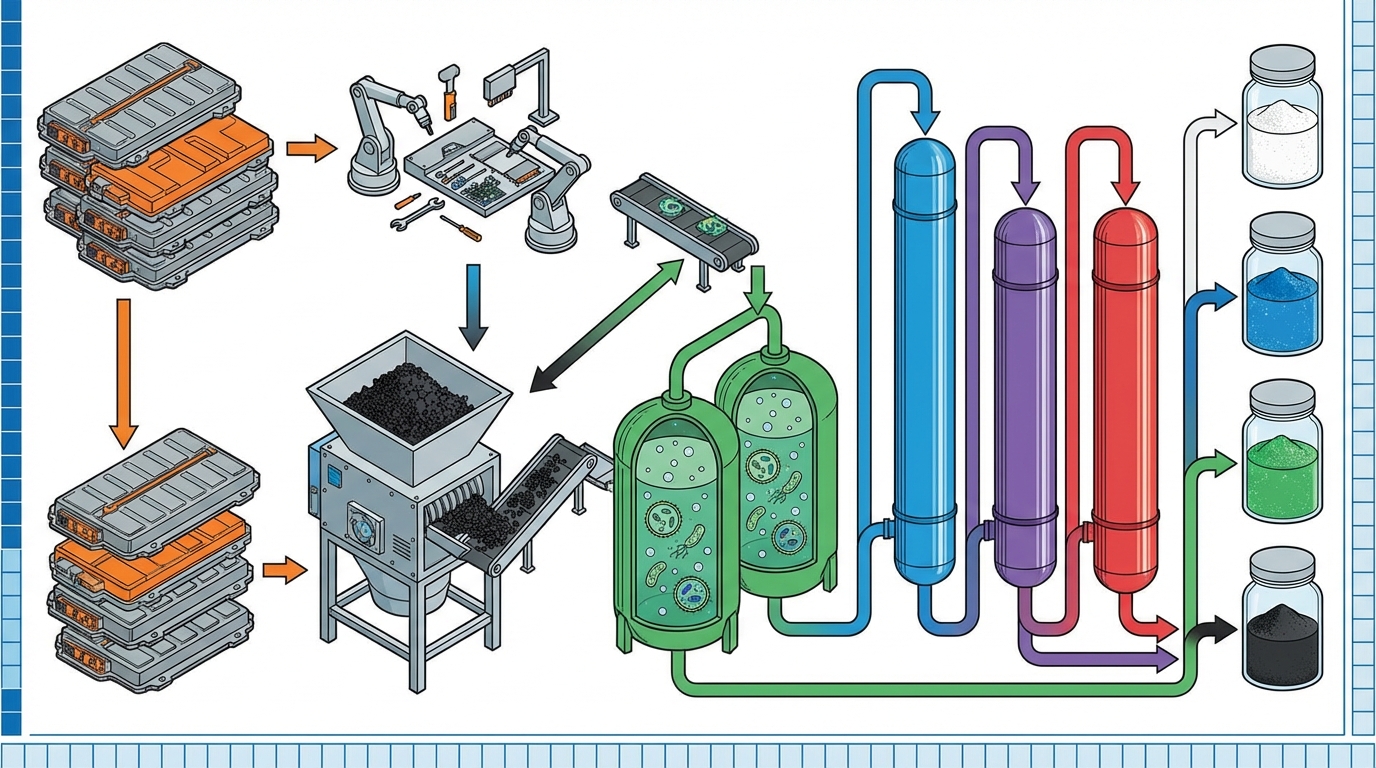
Bioleaching applies specialised microorganisms and controlled chemical environments to dissolve metals from finely shredded battery materials (“black mass”). Laboratory and pilot‑scale results cited in the input point to recovery rates above 95% for cobalt, nickel and sometimes lithium, with claims of lower capital intensity compared with conventional hydrometallurgy. Several EU projects combine hydrometallurgical stages with bioleaching as an optimisation step.
Both technology families already feature in industrial pilots and early commercial plants in Europe. However, the performance figures quoted in the material (such as 90% energy savings or specific recovery rates and cost advantages) typically refer to controlled conditions or project‑specific estimates. They provide an indication of potential but do not yet represent a fully mature, standardised industrial benchmark.
Illustrative project pipeline
The supplied article lists a set of recycling projects in Europe and associated regions, positioning them against the CRMA recycling objective. Examples include established facilities like Umicore’s Hoboken operations in Belgium, joint ventures such as Veolia-Solvay–Renault battery‑recycling pilots in France, magnet‑focused plants such as those of Urban Mining Company in Belgium, and integrated battery‑materials projects linked to cell manufacturers like Northvolt in Sweden or Hydrovolt in Norway.
According to the provided material, these projects span a capacity range from pilot‑scale hundreds of tonnes per year up to larger units targeting tens of thousands of tonnes per year of input material, covering both batteries and magnet‑bearing waste. Several rely on hydrometallurgical and bioleaching hybrids; others focus on direct magnet recycling. The article suggests that, if all progressed as planned and reached nameplate capacities, they could collectively cover a substantial share of the recycling volumes implied by the 15% benchmark, at least for certain SRMs. It is important to stress that these figures are scenario‑based and rely on project pipelines that are still evolving.
INTERPRETATION: Scale‑up challenge, trade‑offs and supply‑chain consequences
A structural gap between ambition and installed capacity
From a procurement and supply‑chain planning standpoint, the most striking feature of the CRMA recycling benchmark is the mismatch between current reality and the 2030 objective. Moving from “below 1%” recycling to “at least 15%” within a few years implies not just incremental improvement, but a structural re‑engineering of how SRM‑rich products are designed, collected, disassembled and processed.
Past experience with environmental targets suggests that the bottleneck is rarely the chemistry alone. It is the combination of:
- collection systems that capture only a fraction of end‑of‑life equipment;
- product designs that embed magnets or batteries deep inside assemblies, making direct access difficult;
- permitting timelines that lag behind political ambitions; and
- uncertainty over long‑term feedstock volumes, which complicates financing.
The CRMA partially addresses permitting through its Strategic Project fast‑tracks and attempts to strengthen collection via traceability and waste measures. However, the real test lies in how quickly industrial actors manage to turn theoretical scrap availability into dependable, contractible flows that can justify multi‑year investments in recycling capacity. In previous cycles, underestimation of this systems‑level complexity has been a recurring blind spot.
Direct magnet recycling and bioleaching: realistic pillars or over‑concentrated bets?
The strong focus on direct magnet recycling and bioleaching in many commentaries reflects genuine potential. In internal evaluations of rare earth and battery supply options, processes that promise high recovery with lower energy input stand out immediately-especially when energy prices and emissions constraints are not abstract variables but direct line items on project dashboards.
At the same time, the deployment history of new metallurgical technologies suggests that reliance on one or two flagship process families can create fragility. Direct magnet recycling, for instance, delivers its best performance when magnets can be separated in relatively intact form. In practice, a significant share of installed motors and generators has not been designed with easy magnet extraction in mind. Without changes in design practices and robust disassembly infrastructure, the accessible magnet pool remains narrower than theoretical availability suggests.
Similarly, bioleaching’s high recovery figures in pilots still need to be proven consistently at scale, across diverse chemistries, while meeting EU environmental and social standards. Scaling bio‑based processes inside regulated industrial zones raises questions about process control, waste streams and community acceptance. In several industrial audits, enthusiasm for laboratory results has historically run ahead of clarity on large‑scale integration and operating cost variability.
If direct recycling and bioleaching deliver at the upper end of the performance ranges cited in the material, they can credibly anchor a substantial portion of the 15% benchmark, particularly for magnet rare earths and battery metals. If their rollout is slower or more constrained, the system will have to lean more heavily on incremental improvements in conventional pyrometallurgy and hydrometallurgy, plus design changes that reduce SRM intensity per unit of output.
Logistics, Basel rules and the geography of recycling
Geography emerges as a decisive variable once Basel Convention constraints and domestic waste rules are taken seriously. The input material notes how restrictions on exporting hazardous intermediates such as battery black mass outside the EU steer the system towards more localised or intra‑EU recycling hubs. This aligns with the CRMA’s desire for domestic capacity but has concrete operational consequences: feedstock catchment areas, rail and road capacity for scrap flows, and local permitting all become critical path items.
From a risk‑management perspective, over‑reliance on a small number of very large hubs can be as problematic as dependence on one foreign refiner. Several past incidents-ranging from unplanned maintenance at smelters to local opposition to plant expansions-have shown how quickly capacity constraints in a single node can cascade into material availability issues upstream. A more distributed network of recycling sites, closer to manufacturing and end‑of‑life collection points, can mitigate some of that risk but complicates standardisation and oversight.
Procurement, contracts and the 65% dependency cap
The CRMA’s 65% cap on reliance on any single third country is likely to drive changes in procurement patterns even before 2030. In practice, many long‑term contracts for SRMs today lean heavily on Chinese refiners or processing steps. If monitoring reveals that a particular material and stage of processing exceeds the 65% threshold, both policy pressure and internal risk frameworks will push for diversification.
In earlier episodes—such as the 2010 rare earth export restrictions or more recent controls on battery‑related materials—rapid repricing and scramble‑style contract renegotiations have not been abstract events. They have translated into real budget revisions, board scrutiny, and at times the temporary suspension of production plans. The CRMA attempts to pre‑emptively structure diversification rather than leaving it to crisis‑driven reactions, but the transition will still involve difficult trade‑offs between security of supply, technical specifications, and economic terms.
Recycling enters this picture as both an additional supply source and a compliance vector. Secondary materials produced in the EU naturally score well against the 65% dependency indicator. However, they also bring specification and qualification challenges: ensuring that recycled cobalt, nickel or rare earths consistently meet stringent quality standards for high‑performance batteries, magnets or aerospace alloys is non‑trivial. In several supplier evaluations, the most robust projects have been those that integrated recycling flows tightly with downstream users, reducing interface risk and aligning quality management from the outset.
Governance lessons: avoiding “spreadsheet circularity”
One recurrent pitfall in strategic discussions about circularity is what might be called “spreadsheet circularity”: counting theoretical end‑of‑life material volumes as if they were bankable feedstock. In past audits of supply‑security plans, SRM volumes were at times double‑counted across reuse, remanufacturing and recycling; attrition in collection and processing was assumed to be negligible; and permitting and ramp‑up periods were treated as short, deterministic intervals.
The CRMA’s legally monitored benchmarks cut against this tendency. Because the 15% recycling target is framed in terms of capacity related to actual EU consumption, and because digital product passports and collection obligations expose real‑world flows, the gap between aspirational circularity in models and delivered tonnages becomes harder to obscure. Governance structures that subject recycling assumptions to the same scrutiny as primary supply contracts appear more robust than approaches that park circularity in a separate, less quantitatively disciplined track.
WHAT TO WATCH: Regulatory and industrial signals
- Delegated and implementing acts under the CRMA: Details on Strategic Project criteria, reporting formats, and how the 15% benchmark will be measured in practice (capacity, actual output, or a combination) will materially shape compliance pathways.
- Digital product passport standards: The scope and granularity of data required for batteries, magnets and large equipment will determine how visible SRM flows become and how easily recyclers can plan around future scrap availability.
- Member‑state penalty regimes: The level and structure of sanctions for non‑compliance, once adopted nationally, will signal how much regulatory risk attaches to underperformance on recycling and diversification benchmarks.
- Final investment decisions (FIDs) for major recycling projects: Announcements on capacity, technology choice and offtake arrangements for key plants in Belgium, France, Germany, the Nordics and neighbouring regions will indicate whether the projected recycling pipeline is materialising.
- Chinese and other third‑country export control measures: New controls on rare earths, battery materials or magnet technologies could accelerate the perceived urgency of CRMA implementation or, conversely, prompt attempts to carve out exemptions.
- Collection rate trends for batteries and e‑waste: Actual uplift in collection of SRM‑rich products by 2026–2028 will be a decisive leading indicator of whether the 15% benchmark is technically attainable without over‑reliance on process scrap.
- Design changes in EV, wind and industrial equipment platforms: Moves towards magnets that are easier to extract, battery pack architectures optimised for disassembly, and material substitution will all influence the recycling potential embedded in future end‑of‑life cohorts.
Note on the methodology TI22 – This briefing combines systematic monitoring of EU regulatory texts and guidance (including the CRMA and related waste and product legislation), review of industry and analyst commentary on recycling projects and technologies, and analysis of how specific SRMs are embedded in end‑use applications such as EVs, wind turbines and defence systems. The focus is on mapping where regulatory requirements intersect with technical feasibility and observed project pipelines, rather than on forecasting prices or prescribing specific commercial arrangements.
Conclusion
The CRMA’s 15% recycling benchmark for strategic raw materials converts long‑standing concerns about SRM dependency into a concrete operational mandate. It forces a reframing of recycling from a peripheral sustainability topic into a core pillar of supply‑security planning, on a timeline that is tight relative to current collection systems, permitting practices and technology maturity.
Whether this benchmark ultimately “changes everything” in SRM markets depends less on the chemistry of direct magnet recycling or bioleaching, and more on mundane but decisive factors: how quickly projects obtain permits, how effectively end‑of‑life products are captured and disassembled, and how consistently secondary materials meet demanding technical specifications. The regulation creates strong signals, but the path from text to tonnage remains contingent on execution.
For boards, procurement teams and engineers used to managing SRM risk primarily through global contracting with a small set of processors, the emerging landscape is measurably more complex but also potentially more resilient if recycling capacity embeds itself credibly into the supply stack. Maintaining active surveillance of weak regulatory and industrial signals – from delegated CRMA acts to project‑level announcements and collection data – will be essential to understand how the balance between primary and secondary SRM supply is actually shifting.
Sources
- EU Critical Raw Materials Act Adopted — European Commission — ec.europa.eu
- EU Sets Binding Targets on Critical Raw Materials Recycling — reuters.com
- The EU’s 15% Recycling Target Could Redefine Critical Materials Supply — ft.com
- What the EU’s Critical Raw Materials Act Means for Industry — politico.eu
- EU Adopts Critical Raw Materials Act with Binding Recycling Aims — euractiv.com
- Europe Pushes for Critical Mineral Recycling to Cut China Reliance — bloomberg.com
- EU Sets Ambitious 15% Critical Materials Recycling Goal — recyclinginternational.com
- Europe’s Race to Recycle Critical Raw Materials — nature.com
- EU’s 15% Recycling Target and Supply-Chain Implications — supplychaindive.com
- How EU Battery Recycling Rules Impact Automakers and Suppliers — cbtnews.com