Introduction: Why the F‑35 Rare Earth Chain Matters
The F‑35 issue is not abstract for anyone who has spent time inside defense supply chains. A few years ago, a temporary halt in F‑35 deliveries over a single magnet containing Chinese-origin alloy exposed just how brittle a multi-billion-dollar aerospace program can be when a small, specialized component goes off-spec. Around the same period, Beijing began tightening controls on critical minerals and magnet technologies, and rare earth prices and lead times became a regular item in risk committee packs. That combination of regulatory leverage and component concentration fundamentally changed the way this topic is viewed inside procurement and industrial-base teams.
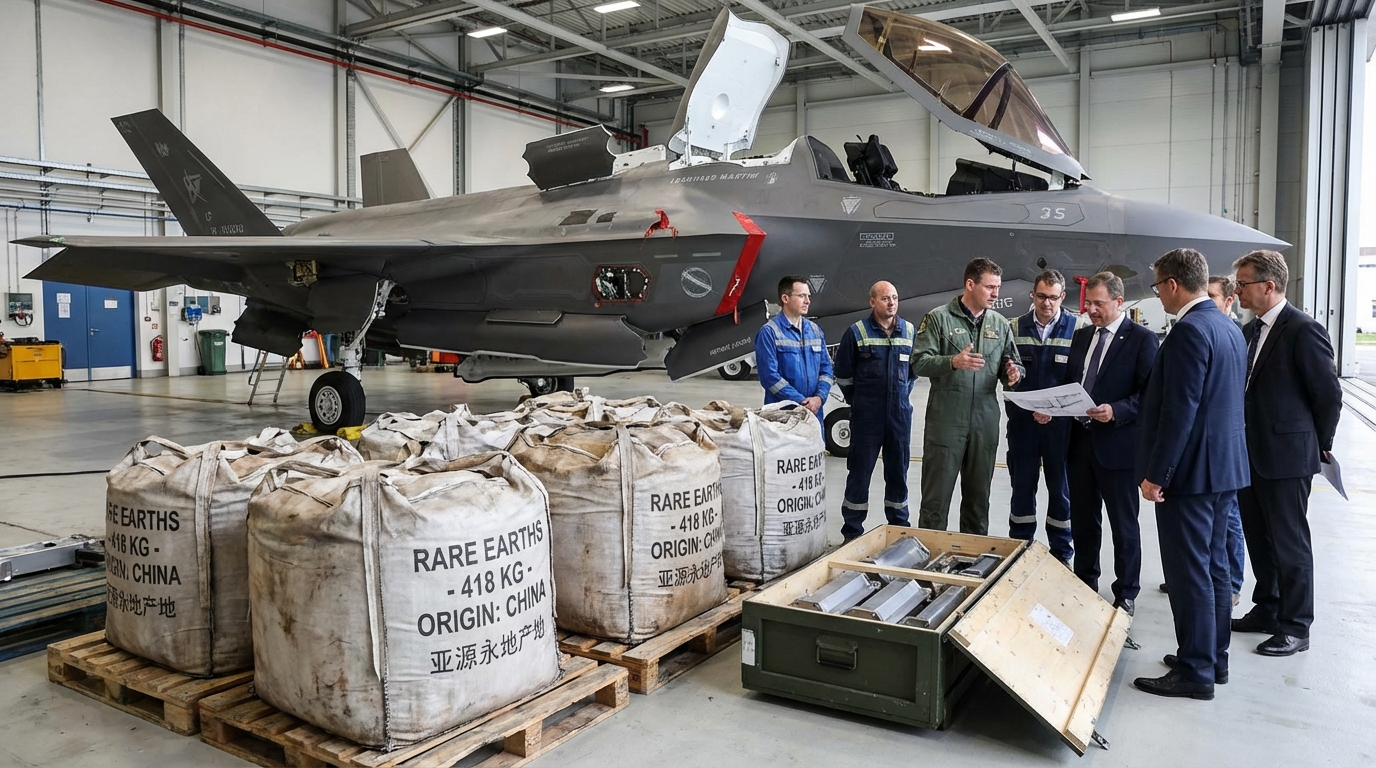
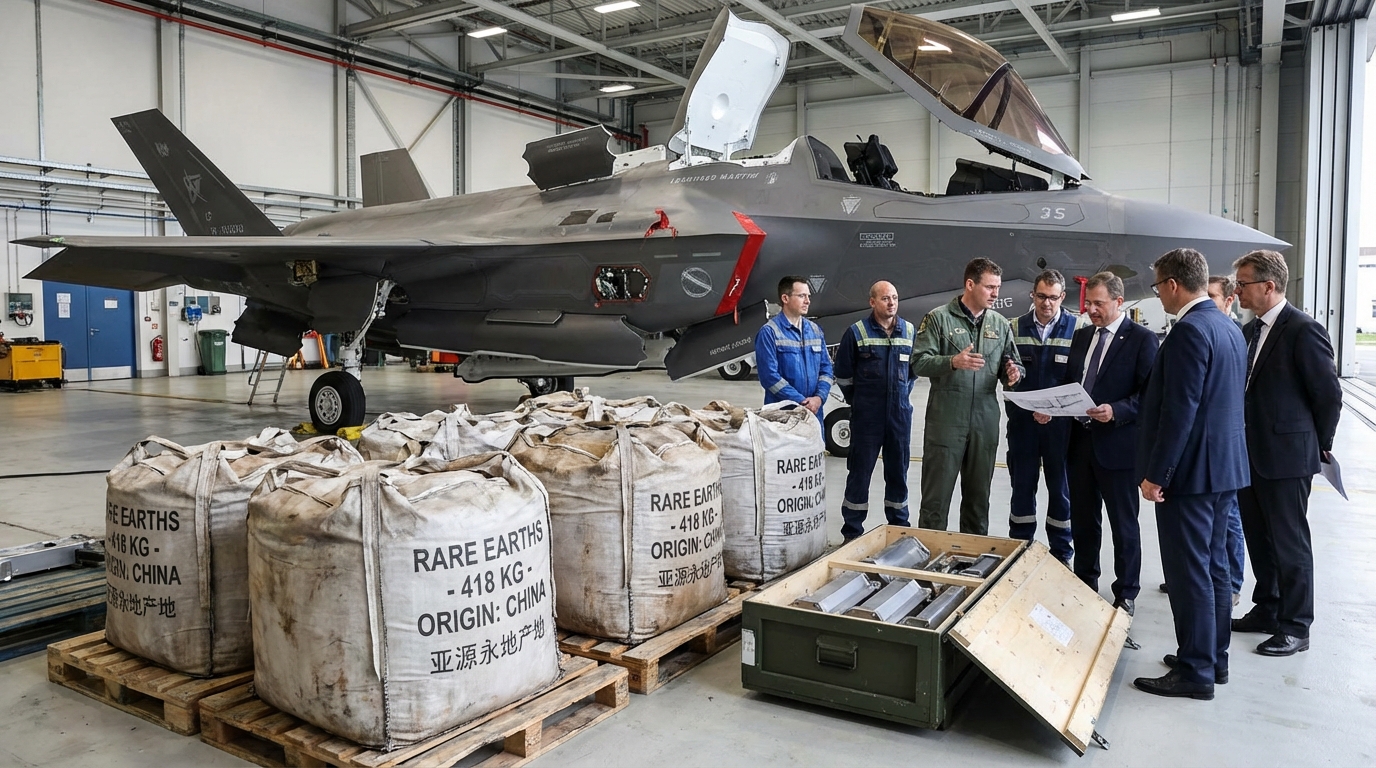
Against that backdrop, the F‑35 stands out as a stress test for Western defense resilience. Open-source analyses indicate that each aircraft embeds roughly 418kg of rare earth elements (around 900 pounds), including samarium in high-performance samarium‑cobalt (SmCo) magnets spread across avionics, actuators, radar and electronic warfare systems. Those magnets must survive extreme temperatures-up to several hundred degrees Celsius-and radiation environments where more common neodymium-iron-boron solutions struggle. That makes the F‑35 unusually exposed to any disruption in SmCo alloy and magnet supply.
China currently refines the overwhelming majority of the world’s rare earths and produces most high-performance permanent magnets. When Beijing moved in 2025 to impose a licensing regime on rare earth products and magnets with any foreign military affiliation, with rules taking effect on 1 December 2025, it effectively acquired a veto over SmCo exports feeding programs such as the F‑35. The Pentagon’s response, including a reported $2 billion Defense Production Act (DPA) package and new provenance requirements in the FY2026 National Defense Authorization Act (NDAA), is reshaping how primes and sub‑tier suppliers think about sourcing, compliance and design choices.
From an operational standpoint, the stakes are straightforward: avoid a repeat of earlier supply incidents, but at program scale and under deliberate external pressure. The following briefing separates the regulatory and technical facts from scenario-based interpretations, focusing on implications for production continuity, supplier portfolios and compliance governance.
- Change in environment: As of December 2025, China applies strict export licensing to rare earth products and magnets linked to foreign militaries, while the United States has activated substantial DPA funding and NDAA sourcing rules for defense-critical minerals.
- Périmètre: The F‑35 program is heavily exposed through roughly 418kg of rare earths per aircraft and extensive use of SmCo magnets, a domain where China has historically controlled 85-95 percent of key processing and magnet-making capacity.
- Operational implications: Internal and external analyses suggest that, under adverse licensing conditions, F‑35 output could undershoot plans by around 20-30 percent in the mid‑2020s unless non‑Chinese capacity, recycling and stockpiles ramp faster than currently scheduled.
- Compliance shift: The FY2026 NDAA pushes toward 100 percent traceability of rare earth provenance in F‑35 lots, transforming magnet chains from “black box” components into audited, reportable line items.
- Limits of current response: Even with roughly $2 billion in DPA support and a 2026 allied stockpile initiative, most non‑Chinese SmCo and separation projects only begin to reach meaningful scale around 2027-2028, leaving a two- to three-year window of elevated risk.
FACTS: Material Dependence, Regulatory Mechanics and Current Measures
F‑35 rare earth content and SmCo magnet roles
Multiple open-source defense analyses, including work by the Modern War Institute at West Point, estimate that each F‑35 incorporates approximately 418kg of rare earth elements. These materials appear in:
- Samarium‑cobalt (SmCo) magnets inside flight control actuators, electric pumps, radar systems, electronic warfare suites and various sensors.
- Neodymium‑based magnets in motors and generators where temperatures are less extreme.
- Other rare earths such as dysprosium, terbium and gadolinium in specialized alloys, guidance systems and thermal management components.
Pentagon assessments cited in open-source commentary indicate that a single F‑35 embeds SmCo magnets in several hundred actuators and sensors. The key technical constraint is thermal performance: SmCo retains magnetic properties and coercivity at temperatures that would demagnetize many neodymium‑iron‑boron magnets. Alternative chemistries such as samarium‑iron‑nitride or advanced ferrites exist, but at present they either underperform at the relevant temperatures or lack the qualification history for mission-critical aerospace use.
An earlier episode illustrated how sensitive the program is to magnet provenance. In 2022, F‑35 deliveries were temporarily paused after discovery that an alloy in a magnet within the engine drive system traced back to a Chinese sub‑supplier, raising questions about compliance with statutory sourcing restrictions. The interruption was resolved, but it set a precedent: small, high‑specification magnetic components can halt an entire final-assembly line if origin or material composition fall outside allowed boundaries.
China’s position in rare earths and magnets
According to analyses by CSIS and others, China refines over 85 percent of the world’s rare earth oxides and produces close to 90 percent of high-performance rare earth permanent magnets, including SmCo and neodymium-based types. The concentration is especially pronounced in midstream steps:
- Separation of mixed rare earth concentrates into individual oxides.
- Metal and alloy production, particularly SmCo alloys with tightly controlled compositions.
- Magnet manufacturing (sintered and bonded), where process know‑how and equipment are highly specialized.
This dominance has been leveraged before. In 2010, export restrictions and de facto embargoes on rare earths to Japan triggered global price spikes and accelerated diversification efforts. More recently, China has introduced licensing for exports of gallium, germanium and certain rare earth magnet manufacturing technologies, explicitly citing national security and foreign policy considerations. The 2025 steps on SmCo products thus extend an existing pattern of using regulatory tools to shape access to strategic materials.
China’s December 1, 2025 export licensing regime
According to the sources provided, China’s Ministry of Commerce (MOFCOM) and related agencies implemented new controls that came into force on 1 December 2025. Key factual elements reported include:
- Scope: SmCo alloys, certain rare earth oxides and high-performance rare earth magnets are subject to export licensing if there is any link to foreign militaries or military end use.
- Presumption of denial: Licenses for exports with “any affiliation to foreign militaries” are reportedly auto‑denied, which in practice covers direct sales to U.S. defense primes and many sub‑tier suppliers.
- End-use scrutiny: Applications require detailed end-user declarations, technical specifications and intended application disclosures, giving Chinese authorities fine-grained visibility into downstream military supply chains.
- Transshipment coverage: The regime extends to re-exports via intermediaries such as Hong Kong, with enforcement targeting routing patterns historically used to mask final destinations.
The “SmCo alloy incident” referred to in the input material describes a crystallizing moment in mid‑2025 when license denials for SmCo products associated with U.S. defense programs made clear that these new rules were being applied in a highly restrictive way. This coincided with reports of rising domestic Chinese demand for rare earth-based steels and alloys in infrastructure projects, further tightening export availability.
Pentagon’s 2025 Defense Production Act package
On the U.S. side, the Department of Defense (DoD) has progressively turned to Defense Production Act (DPA) authorities to address critical mineral vulnerabilities. Public records prior to 2025 already show DPA Title III support for projects involving MP Materials (Mountain Pass, California), Lynas Rare Earths (including its U.S. processing plans), and multiple magnet and separation initiatives.
Building on that foundation, the input material describes a 2025 DPA package of around $2 billion targeted specifically at rare earths and magnets, including:
- Funding for domestic SmCo magnet qualification at an established U.S. magnet producer, aiming to certify magnets for F‑35 use around 2027.
- Substantial capital for heavy rare earth separation capacity at Lynas’s Kalgoorlie facility in Western Australia, with a focus on samarium and gadolinium streams relevant for defense alloys and magnets.
- Pilot support to U.S.-based projects working on separation and co‑recovery of samarium and other magnet-critical elements.
The exact amounts and schedules cited in the input (for example, hundreds of millions of dollars for individual projects and specific annual tonnage capacities) reflect program-level disclosures and industry reporting. What matters operationally is that the Pentagon is moving beyond studies toward direct co‑funding of non‑Chinese mining, separation and magnet production linked to defense requirements.
Allied coordination and provenance rules
Several allied policy initiatives frame the broader environment described in the input:
- A 2026 Critical Minerals Ministerial reportedly gathered 15 allied countries and agreed in principle to coordinate stockpiling of SmCo alloys and to pursue joint procurement from jurisdictions such as Australia and Vietnam.
- The FY2026 NDAA is described as mandating 100 percent auditability of rare earth provenance for F‑35 production lots from early 2026 onwards, with contractual penalties tied to non‑compliance.
- Export control and mining ministries in countries including Australia, Canada and the United States have launched or expanded regimes governing critical mineral exports, environmental permitting and indigenous consultation, all of which shape how quickly non‑Chinese projects can advance.
Alongside policy, a portfolio of non‑Chinese rare earth and magnet projects is emerging. The input highlights assets in the United States (e.g., Mountain Pass and Round Top in Texas), Australia (Mt Weld and associated processing in Kalgoorlie; Browns Range; Dubbo), Canada (Nechalacho, Wicheeda), Africa (projects in Tanzania and South Africa), Brazil, Greenland and India. Timelines and capacities vary widely, but a common feature is that most of these projects are either in ramp‑up or pre‑production phases during the mid‑2020s, rather than already operating at full, defense‑qualified scale.
INTERPRETATION: Supply Chain Risk, Timelines and Trade-Offs
Single-point-of-failure risk for F‑35 production
From a supply chain risk perspective, the combination of facts above is uncomfortable. A platform that consumes hundreds of kilograms of rare earths per unit, with mission-critical reliance on SmCo magnets, is now tied to a material stream where one country both dominates processing and has chosen to deploy export controls explicitly keyed to foreign military affiliation.
Internal and external modelling exercises cited in the input suggest that under a strict application of the 2025 Chinese licensing regime, and absent accelerated diversification, F‑35 deliveries could undershoot planned numbers by roughly 20–30 percent by mid‑2026. These figures are scenario outputs, not certainties, but they illustrate the order of magnitude at stake. In some projections, Lockheed Martin’s Fort Worth assembly lines risk idling for 12–18 weeks per 50‑jet batch if SmCo magnets or alloys are delayed.
Experience from previous audits across electromechanical and avionics suppliers suggests that these kinds of dependencies are often more concentrated than bill-of-materials spreadsheets imply. A single approved SmCo magnet design may be produced by one or two facilities globally, even if there appear to be multiple catalog suppliers. Where extensive re‑qualification is required, lead times measured in years rather than months are common. That dynamic amplifies the impact of a licensing shock at the alloy or magnet level.
Timeline tension: 2025 controls vs 2027+ allied capacity
Another clear theme is timing. Chinese controls on SmCo products linked to foreign militaries came into effect on 1 December 2025. Many of the non‑Chinese projects highlighted-new separation plants, magnet lines, and heavy rare earth developments—target initial or partial production between 2026 and 2028. Pentagon-supported magnet qualification for F‑35 applications is described as aiming for mid‑2027 certification.
During that 2025–2027 window, global non‑Chinese SmCo separation and alloy capacity remains limited. The input material references estimates that non‑Chinese capacity accounts for less than 10 percent of global SmCo separation post‑controls, with an annual shortfall on the order of 2,000 metric tonnes. If those approximate figures hold, the system faces a structural deficit in precisely the material class that underpins F‑35 magnets and other high-temperature defense applications.
Some scenarios compiled in the input suggest that, if all the listed allied projects ramp successfully, 40–50 percent of U.S. SmCo needs could be covered by non‑Chinese sources by around 2028. That would materially reduce single-country dependence, but it does not resolve the interim gap. In practical terms, the “risk peak” appears in the mid‑2020s, not at the end of the decade.
Operational trade-offs: speed, compliance and design choices
For program offices, primes and major sub‑suppliers, these dynamics translate into hard trade-offs.
- Speed vs. qualification rigor. Shifting from Chinese to non‑Chinese SmCo suppliers involves not just a new purchase order but full qualification, reliability testing and often minor redesigns. Compressing those processes to fit the 2025–2027 window risks either slower ramp‑up or increased technical and quality risk.
- Compliance vs. flexibility. The FY2026 NDAA push for 100 percent provenance auditability means magnet supply chains are no longer opaque. Workarounds such as blending small amounts of Chinese-origin material into otherwise allied supply could collide with statutory requirements and contractual penalties.
- Stockpiles vs. just‑in‑time. The 2026 Critical Minerals Ministerial’s aspiration for six‑month SmCo buffers reflects a recognition that just‑in‑time delivery is poorly matched to export-controlled materials. Building and rotating such stockpiles, however, ties up working capital and complicates inventory accounting, especially when handling classified or ITAR-controlled components.
- Design conservatism vs. substitution. Moving away from SmCo toward alternative magnet materials (such as samarium‑iron‑nitride or advanced ferrites) could reduce exposure to specific Chinese-controlled steps, but only if performance requirements, thermal margins and lifetime reliability are all re‑validated—a non‑trivial engineering effort.
From firsthand experience with supplier audits, design engineers are often reluctant to reopen qualified configurations unless absolutely necessary, especially on safety- and mission-critical systems. At the same time, compliance teams are increasingly unwilling to sign off on parts with uncertain provenance in the current regulatory climate. The F‑35 SmCo chain is caught exactly at that intersection.
Non‑Chinese SmCo options: portfolio and constraints
The dozen projects listed in the input—spanning the United States, Australia, Canada, Africa, Brazil, Greenland and India—illustrate both the opportunity and the constraint set.
- North American projects such as Mountain Pass (MP Materials), Round Top (USA Rare Earth), Nechalacho (Vital Metals) and Wicheeda (Defense Metals) offer geopolitical alignment and shorter logistics chains to U.S. primes. Several already produce or plan to produce mixed concentrates, with progression toward separated oxides and eventually magnet alloys. Environmental permitting, indigenous rights processes and technical ramp‑up all affect timing.
- Australian assets like Mt Weld and the Kalgoorlie separation plant (Lynas), Browns Range (Northern Minerals) and Dubbo (Australian Strategic Materials) combine relatively low geopolitical risk with established mining jurisdictions. However, competition from other customers (including Japanese and European magnet makers) and domestic labor and infrastructure constraints limit how much feedstock can be redirected to U.S. defense applications in the short term.
- African, Brazilian and Greenlandic projects expand the long-term option set, often leveraging by‑product recovery from existing mining or processing operations. Here the main constraints are infrastructure, financing conditions, political stability and, in some cases, overlapping sensitivities around uranium or other co‑products.
According to the scenario analysis in the input, even if these projects perform broadly as planned, they collectively fall short of fully replacing Chinese SmCo supply for U.S. defense demand before the late 2020s. That conclusion is consistent with prior observations from mining and processing projects: moving from resource to qualified component often takes a decade or more, especially when environmental, social and governance standards are stringent.
Governance, tracing and evasion patterns
The shift to tighter provenance rules in the FY2026 NDAA is already influencing governance and information systems. The input mentions pilots using blockchain-based traceability tools for magnet supply, as well as audits that have uncovered attempts to route Chinese-origin rare earth products through intermediaries such as Hong Kong or Vietnam to mask origin. Whether or not such pilots scale, the direction of travel is clear: magnet and alloy supply is moving from a relatively low-visibility commodity input to a high-visibility compliance focus.
In practice, that means purchasing, legal and engineering functions are increasingly interlocked. Design changes that enable multi‑sourcing or substitution can materially alter compliance risk; procurement choices that chase short lead times from opaque suppliers can unwind years of qualification work if origin is later questioned. From a governance point of view, SmCo and other rare earth-dependent components are now in the same category as semiconductors: sensitive, audited and politically exposed.
Budgetary and industrial-base implications
The input references expectations that shifting away from Chinese SmCo and allied export controls could drive mid‑teens percentage increases in component or system-level costs for some defense platforms. These estimates are inherently uncertain and depend heavily on contracting structures, stockpile strategies and the degree of redesign or requalification required.
What is clearer is the scale of industrial-base commitment implied. Scenario analyses cited suggest that meaningfully de‑risking SmCo supply for F‑35 and other platforms would involve DPA and related funding on the order of multiple billions of dollars, potentially including expansions beyond the reported $2 billion 2025 package. Some commentators argue that, without such scaling, risks of multi‑year delivery delays and budget overruns in the tens of billions of dollars could persist. These are not investment theses; they are reflections of the capital intensity and timeframes involved in reproducing a midstream industrial ecosystem that took China decades to build.
WHAT TO WATCH: Key Indicators and Weak Signals
Several concrete indicators can help track whether the F‑35 SmCo risk profile is improving or deteriorating. None of them, taken alone, is decisive; together, they form a practical dashboard for monitoring the evolving balance between Chinese control and allied resilience.
- Chinese regulatory moves. Any expansion, relaxation or clarification of MOFCOM’s December 2025 licensing regime for rare earth products and high-performance magnets—especially with respect to “foreign military affiliation” definitions and transshipment treatment.
- License approval data and anecdotal lead times. Patterns in how quickly export licenses are processed, which categories are systematically denied, and how Chinese suppliers communicate changed conditions to overseas customers.
- DPA and NDAA follow-through. Appropriation levels, project selection and milestone performance for the 2025 DPA rare earth and magnet package, and any additional measures introduced in subsequent NDAA cycles targeting magnet and alloy sourcing.
- Project milestones at key non‑Chinese assets. Commissioning and ramp‑up at facilities such as Mountain Pass, Kalgoorlie, Browns Range, Nechalacho and Round Top, especially where outputs are contractually linked to defense applications.
- Evidence of magnet design diversification. Public or semi‑public indications that primes and Tier‑1 suppliers are qualifying multiple non‑Chinese SmCo sources or exploring alternative magnet chemistries for F‑35 subsystems.
- Enforcement and audit outcomes. Reports of non‑compliance findings related to rare earth provenance in defense contracts, including any penalties triggered under the FY2026 NDAA regime.
- Allied coordination mechanisms. Concrete outputs from forums such as the Critical Minerals Ministerial or the Minerals Security Partnership: joint procurement announcements, shared stockpiling arrangements, or aligned export policies.
- Program schedule adjustments. Any revisions to F‑35 delivery schedules explicitly attributed to materials or magnet supply issues, as opposed to software, engine or airframe factors.
Across previous critical-materials episodes—the 2010 rare earth shock, the more recent gallium and germanium controls—early signals often appeared first in export paperwork, ship-track data, and supplier lead-time notices rather than in formal policy statements. The same pattern is likely around SmCo and F‑35-relevant magnet supply.
Note on the methodology TI22 This briefing combines close monitoring of official texts and announcements from bodies such as MOFCOM, the U.S. Department of Defense, and allied trade and mining ministries with open-source market reporting on rare earth and magnet projects, alongside analysis of the technical specifications for defense-grade magnets and actuators in platforms like the F‑35. No proprietary volume, price or contract data are used, and all forward-looking elements are explicitly framed as scenarios or interpretations rather than predictions.
Conclusion
The F‑35’s dependence on Chinese-linked SmCo alloys and magnets is no longer a theoretical vulnerability; it is being stress‑tested by an explicit export licensing regime that treats foreign military end use as a red line. The Pentagon’s DPA interventions, allied coordination around stockpiles, and tightening provenance requirements in the FY2026 NDAA collectively mark a decisive shift from acknowledging the problem to attempting to re‑engineer the industrial base.
At the same time, the physics of magnet performance, the timelines of mining and separation projects, and the inertia of aerospace qualification cycles create a near-term window in which risk remains elevated. Whether the system converges toward resilience or endures periodic production shocks will depend less on single flagship projects and more on the cumulative effect of many incremental decisions across design, sourcing, permitting and enforcement. In that sense, active monitoring of weak regulatory and industrial signals around rare earths and magnets will continue to be central to understanding the trajectory of the F‑35 program and related defense supply chains.
Sources
- Pentagon Halts F‑35 Deliveries Over Chinese-Origin Alloy — reuters.com
- China Targets Rare Earths in New Export Licensing Rules — ft.com
- China Imposes Export Licensing on Rare Earth Magnets Linked to Foreign Militaries — bloomberg.com
- Pentagon Injects $2B into Rare Earth Supply Chain to Support F‑35 Program — defensenews.com
- China’s Rare Earth Monopoly and U.S. Defense Dependency — csis.org
- F‑35 Magnets Reveal Dependence on Rare Earth Supply Chain — militaryaerospace.com
- Chinese Critical Minerals and the F‑35 Risk Analysis — modernwarinstitute.org
- China’s Export Licences on Rare Earth Magnets Tighten Grip on Defense Products — scmp.com
- DoD Announces Defense Production Act Funds for Rare Earth and Magnet Projects — defense.gov
- FY2026 NDAA Mandates Rare Earth Traceability in Defense Contracts — politico.com